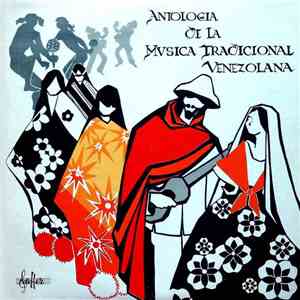
Tracklist
| a1 |
La pava |
| a2 |
Tono de carité |
| a3 |
Canto coral yukpa |
| a4 |
Canto de pilón |
| a5 |
La perra |
| a6 |
Pastores de Mariara |
| a7 |
Rito de Tura |
| a8 |
Tropezón |
| a9 |
Rajuñao |
| a10 |
Maremare |
| a11 |
Angorongomez |
| a12 |
Trompa guajira |
| a13 |
Aoru-ra |
| a14 |
Los calambres / Caballito |
| a15 |
Marisela o "La guabina" o "La revuelta" |
| b1 |
Aoru-ra |
| b2 |
Pretendí a una señorita |
| b3 |
Flauta funeraria |
| b4 |
La despedida |
| b5 |
Aguinaldo (Indígena) |
| b6 |
El cura me regañó |
| b7 |
La batalla o "La presentación de San Antonio" |
| b8 |
Canción de ordeño |
| b9 |
El aguacero |
| b10 |
Cantos shamánicos |
| b11 |
Jota |
| b12 |
Quirpa |
| b13 |
El capitán cayó en el hoyo |
| b14 |
Malagueña |
| b15 |
Polo |
Notes
PART I 1) LA PAVA (CRESTED GUAN or wild "turkey"), is a "golpe" or rhythm from Aragua State, played on a local Araguan harp, which differs from the plains or "llanero" harp in having a larger number of strings. The five for bass notes are made out of deer gut; the 16 strings of the middle register are made of nylon; and the 12 strings of the upper register are made of steel. The "golpe" is a variation of the Joropo, national dance of Venezuela. Recorded at Villa de Cura, Aragua State, April 1, 1973, performed by the blind harpist Alfredo Sanchez, a 25-year-old farmboy. 2) TONO DE CARITE is a wake for a dead child. "Tonos" could be considered as polyphonic songs for two and three voices, sometimes accompanied, as in this case by a "cuatro" (small fourstringed guitar) and violin. The polyphony is harmonic and contrapuntual, sung by totally untrained voices. Recorded in the hamlet of La Tintorera near Quibor, Lara State, April 27, 1957. 3) CANTO CORAL YUKPA (YUKPA CHORAL CHANT) is in reality a collection of voices chanting during a ritual dance of the Yupka tribe, indians of Carib stock. This chant was recorded in the Sierra de Perija, headwaters of the Tukuko River, Zulia State, on January 15, 1959. This "polyphonic" chant is one of the songs and dances which are celebrated during the full moon in rituals stimulated by "chicha", a fermented drink make of ground corn and mashed bananas. 4) CANTO DE P1L0N (CORN-GRINDING SONG) is sung only by women while they are pounding the corn. This chant seems to echo the pounding job as the women grapp the heavy wood pestles, raising them rhythmically over the mortar, a large trunk with a hollow in the upright end to hold the grain. The woman sings a ballad separated between verses by a phoneme that sounds something like jay, joy or simply ay. In general the songs refer to love affairs. The rhythm is always binary. Recorded at Campoma, Ribero District, Sucre State, October 13, 1973. 5) LA PERRA (THE BITCH), a chant and dance accompanied by the long drum, is performed during the Feast of St. John the Baptist in the Barlovento region of Miranda State, east of Caracas. An incantation accompanying the dance invokes magic aid in the hunt, in this case of a paca, a type of rodent the size of a rabbit. The drum is a Tam-bor Largo or long drum played in unison with several others, creating a rich and interesting polyrhythm. Recorded at Aricagua, Miranda State, March 10, 1971. 6) PASTORES DE MARIARA (MARIARA SHEPHERDS), is a "pa-rranda" or Christmas celebration. The monodic song is accompanied by a "cuatro" or four-string guitar, a "botijuela" — clay wind instrument, and some percussion instruments such as maracas and the "furruco" or "zambomba" of Spanish origin. Male dancers dressed as women, feign fear of the central figure disguised as a bull which must dominate them. The ritual is performed by villagers who have made religious promises to do so during the year. It is a tradition rooted in villages of Carabobo State, east of Valencia. Recorded at Aguas Calientes, Mariara, December 8, 1957. 7) RITO DE TURA (RITE OF "TURA"), (Dance of the Hunters). No one knows the origin of the word "tura". Today the name is applied to an ancestral rite involving dance and music. The wind instruments, made of "carrizo", a common reed growing on the banks of our rivers, include: the "tura", the "turitas", "tura hembra" (female) and "tura macho" (male). This rite takes place during the corn harvest. Today, the tradition is maintained by the descendants of the Ayaman, the Gayon
and Jirajara Indians. In this recording we include the "Hunter's Dance", part of the "Tura Pequena" or "Mazamorra". Another variety is the "Tura Grande" or "Llora" (Weeping), a secret rite performed in fulfilment of a religious promise, or danced in memory of the dead. It is performed in caves or in stone houses outside of town. The "tura" here selected is played with the "quena" flute of three holes and another of four; a pierced maraca, and the skull of a deer or "matacan". The skull, its openings and fissures sealed with beeswax, becomes a musical instrument that is blown through the spinal cord opening. Recorded at Tapialito, Quebrada de Piritu, the House of the Spirits, Municipality of Agua Grande, Lara State. PART 2 1) TROPEZON (STUMBLE, CHANCE MEETING), a "golpe llane-ro" or plains rhythm, is played on the bandolin, the "cuatro" (four-string guitar) and maracas. It has a ternary beat with a very lively rhythm. The bandolin carries the solo while the cuatro and maracas make up the accompaniment. Recorded in Maporal, Barinas State, September 9, 1973. 2) RAJUNAO. The drum pieces of coastal regions in Venezuela are very varied. The melody sung by the soloist is accompanied by a battery of drums of different sizes, from the "mina", "tambor redondo" or round drum, to the "curbeta". In this piece, clearly of African origin, the "soloist" is accompanied by a choir without polyphonic or even hetero-phonic traces. The choir is made up of men and women. It is interesting to note the multiple rhythms formed by the drums, in this case the round drum which is called "culo e puya". Collected at Curiepe, Miranda State, October 10, 1973. 3) MAREMARE. This piece is of aboriginal origin, even if by now it has lost its autochthonous essence, of which remains only the "flautas de pan" made of river reeds. In this recording we include a local form of the dance whose music descends from the Coaca Indians of Carib filiation. The "Maremare" of Cumanacoa has several parts of "toques": "El Perro" (The Dog), "Comecandela" (Fire Eater) and "El Cangrejo" (The Crab). In the version here are: "flautas de pan", drum, "guarura" or the large conch, a kind of murex. Recorded at Cumanacoa, Sucre State, July 29, 1972. 4) ROMANCE DE LA VIRGEN BELLA (BALLAD OF THE BEAUTIFUL VIRGIN). This very old ballad, Spanish in origin, is pre-Renais-sance. The "melismas" noted bring us hints of Gregorian plainsong. It was recorded in a very remote town in the Andes, El Rincon, Canagiia, south of the city of Merida, Merida State, on August 21, 1968. 5) SANGORONGOMEZ, a part of the musical suite and dance honoring St. Benedict, a Negro saint, is also known as "CHIMBANGUELERO". In rendering it, each region employs different instruments. In the Lake Maracaibo area the people normally use drums, while in the Andes string instruments are used. In this recording made in Palmarito, Merida State, on December 28, 1968, we notice a nose flute and sometimes an ordinary flute. During the street procession in which the saint is borne on a platform, the parishioners and paraders wave banners and sometimes play a large maraca. In the town of Mucuchies, Merida State, they also dance the "GIROS DE SAN BENITO" (the gyrations of St. Benedict). 6) TROMPA GUAJIRA, aboriginal music of the Guajiro Indians, is played on a small instrument known in Africa and Europe as a Jew's Harp, in common use today by the Guajiros. The instrument seems to be a native creation made of a thin reed spear with a string tensed over it. It is played softly with the fingernail, its resonance being due to the fact that the player holds the instrument in his teeth thus making the mouth and cranial cavity into a resonating box. Recorded near Pa-raguaipoa, Zulia State, April 17, 1971. 7) LOS CALAMBRES - CABALLITO (THE CRAMPS - PONY), music and dance which comes from the "TAMUNA NGUE", a dance in nine parts, from the state of Lara. Other parts include: "St. Anthony and the Battle", "Yiyivamos", "The Beauty", etc. In the Tamunangue one notices traces of African origin and some native Indian forms, as well as music of Spanish origin. The Sixth Part, "LOS CALAMBRES", reproduced on this band, was performed by farm workers of Hacienda San Rafael near El Tocuyo, Lara State, December 1, 1957. PART 3 1) M ARISE LA OR LA GUABINA OR LA REVUE LT A is a folklore suite from Aragua State consisting of several sections: "EL PASAJE" — the Landscape, "LA GUABIN A" — a fish, "EL YAGUASO", and "LA MARI-SELA". Played in combinations of 3/4 and 6/8 time, the variety of ex-pression in the melody and accompaniment form a rhythmic richness which is truly attractive. Here we reproduce the suite played by blind harpist, Alfredo Sanchez, on his Araguan harp; recorded at Villa de Cura, Aragua State, on April 1, 1973. This beautiful music is reminiscent of the harpsichordists Scarlatti and Soler. 2) AORU-RA is a kind of clarinet with a sound somewhat like an English horn. Of pure aboriginal origin, it comes from the Parajuanos Indians of Arawak filiation. The "AORU-RA", in five parts, is made of reed, an ancient instrument which is similar to others of ancient Far Eastern cultures. Recorded at Sinamaica Lagoon, Zulia State, January 2, 1973.